 EN

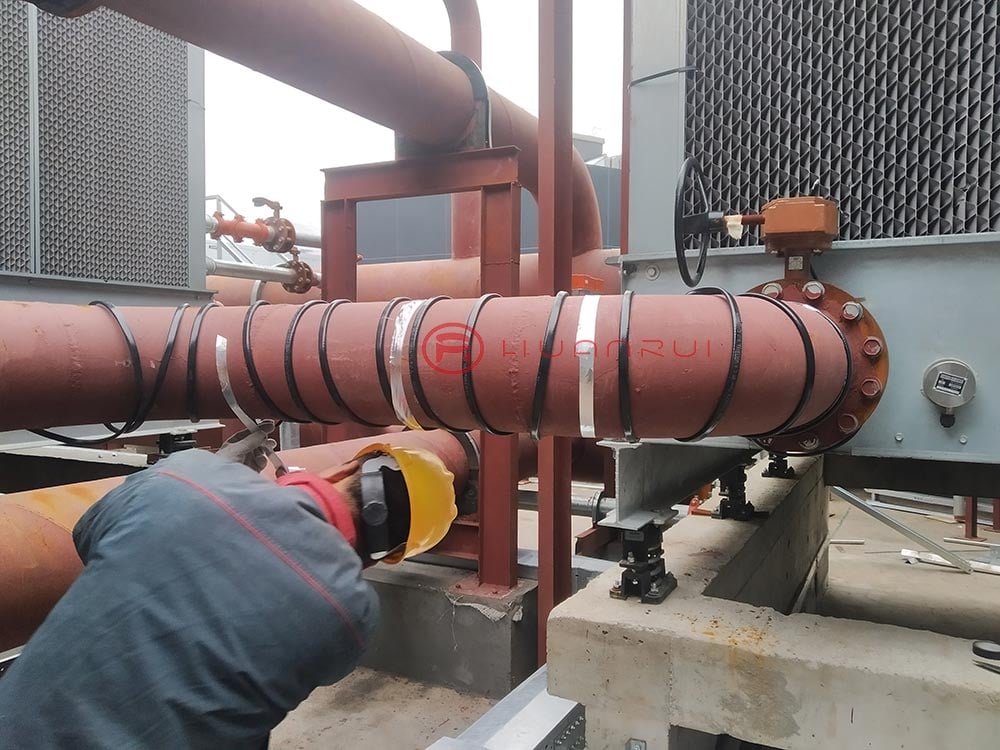
Cold weather can pose serious risks to water pipes, roof gutters, industrial pipelines, and outdoor facilities. As temperatures drop, liquids inside pipes may freeze, expand, or become too viscous to flow properly, potentially causing equipment damage, operational interruptions, and costly repairs.
Self Regulating Heat Tape is designed to address these challenges through automatic heat output adjustment. It increases its heat output in colder areas and reduces it in warmer areas, making it a practical solution for many residential and industrial freeze protection and temperature maintenance applications.
But how does Self Regulating Heat Tape adjust its heating power automatically?
The answer lies in its Positive Temperature Coefficient (PTC) conductive polymer core, whose electrical resistance changes in response to temperature variations.
1. The Working Principle: PTC Technology
The heating element of Self Regulating Heat Tape consists of a conductive polymer matrix with Positive Temperature Coefficient (PTC) characteristics.
In simple terms, the electrical resistance of this material increases as its temperature rises and decreases as its temperature falls.
When the temperature decreases, the conductive polymer matrix contracts. Conductive particles move into closer contact, increasing the number of conductive pathways through the material. This reduces electrical resistance, allowing more current to flow and increasing heat output.
When the temperature increases, the polymer matrix expands. Some conductive pathways become disrupted as the conductive particles move farther apart. Electrical resistance increases, current decreases, and the cable automatically reduces its heat output.
This process is continuously repeated while the cable remains energized.
Unlike conventional heating cables that deliver a relatively fixed output under specified operating conditions, Self Regulating Heat Tape responds to temperature variations along its length. Different cable sections can therefore produce different amounts of heat according to their local thermal conditions.
It is important to understand that self regulation adjusts heat output; it does not maintain an exact preset temperature or automatically disconnect the power supply.
2. How Self Regulation Works Along the Cable
One of the main advantages of Self Regulating Heat Tape is its ability to adjust heat output locally along the same cable.
The conductive polymer core responds to temperature variations at different positions, allowing individual sections to increase or decrease their heating output according to surrounding conditions.
For example:
• Sections installed in cold pipe shafts or exposed outdoor areas produce more heat.
• Sections located in warmer utility rooms automatically reduce their heat output.
• Sections passing through building entrances or areas with changing temperatures continuously adapt to local thermal conditions.
This localized adjustment helps reduce unnecessary heat generation in warmer areas while providing additional heating where heat loss is greater.
However, actual heat output depends on cable specifications, supply voltage, installation conditions, thermal insulation, and the temperature of the cable itself.
3. Typical Construction of Self Regulating Heat Tape
A standard Self Regulating Heating Cable generally consists of several functional layers:
1. Bus Wires: Two parallel copper conductors that distribute electrical power along the cable.
2. Conductive Polymer Heating Core: The PTC heating element that changes electrical resistance in response to temperature variations.
3. Primary Insulation: An electrical insulation layer that separates the heating core and conductors from the surrounding protective structure.
4. Metallic Braid (Optional): A grounding and protective layer included in certain cable designs to provide electrical grounding, mechanical protection, or shielding.
5. Outer Jacket: The external protective covering designed to resist environmental exposure, moisture, and mechanical damage according to the cable's specified rating.
The exact construction varies by product model and application. Metallic braiding, outer jacket materials, and other protective layers should always be checked against the manufacturer's technical specifications.
4. Does Self Regulating Heat Tape Need a Thermostat?
This is one of the most common questions about Self Regulating Heat Tape.
For many basic freeze protection applications, Self Regulating Heat Tape can adjust its heat output through its built-in PTC characteristics without requiring a thermostat to regulate the output of each cable section.
However, self regulation does not mean that the cable automatically switches itself off.
There are two different functions to understand:
• Self Regulation: Adjusts the heat output of individual cable sections according to local temperature conditions.
• Thermostat Control: Controls the electrical power supply to the entire heating circuit or a designated circuit section.
As long as the cable remains energized, it may continue to consume electricity even when its heat output has decreased.
A thermostat or suitable control system can disconnect power when heating is unnecessary. For larger installations, industrial applications, or projects with specific energy management requirements, an appropriate control system is recommended.
The need for temperature control depends on the application, design specifications, operating conditions, and applicable electrical requirements.
5. Self Regulating vs. Constant Wattage Heat Tape
Self Regulating and constant wattage heating cables are two common types of electric heat tracing products. Although both are used for freeze protection and temperature maintenance, their heating mechanisms are different.
Self Regulating Heat Tape
Self Regulating Heat Tape uses a PTC conductive polymer core to adjust its heat output in response to temperature variations.
Colder sections generally produce more heat, while warmer sections reduce their output. This makes Self Regulating Heating Cable suitable for installation routes with varying temperature conditions.
Constant Wattage Heat Tape
Constant wattage heat tape is designed to provide a relatively consistent rated heat output per unit length under specified operating conditions.
Unlike Self Regulating Heating Cable, it does not use a PTC conductive polymer core to automatically adjust its output according to local temperature changes.
Its design requires careful consideration of operating temperature, heat loss, cable spacing, circuit configuration, and temperature control.
Which Type Should You Choose?
Neither type is universally better. The appropriate choice depends on:
• Required process or maintenance temperature.
• Calculated heat loss.
• Pipe diameter, material, and installation layout.
• Ambient temperature and environmental conditions.
• Cable power output and maximum exposure temperature.
• Control requirements and project specifications.
A proper thermal design and product selection process is essential for reliable operation.
6. Common Applications of Self Regulating Heat Tape
Self Regulating Heating Cables are widely used in residential, commercial, and industrial applications.
Typical applications include:
Pipe Freeze Protection
Protecting water supply lines, outdoor pipes, and industrial pipelines from freezing in cold environments.
Roof and Gutter Ice Protection
Preventing ice accumulation and supporting drainage in suitable roof edges, gutters, and downspouts when an approved roof de-icing cable system is used.
Snow and Ice Melting
Providing heating for designated outdoor surfaces such as walkways, ramps, and stairs when the cable is specifically designed and approved for ground snow-melting applications.
Industrial Process Temperature Maintenance
Maintaining the required temperature of process media in pipelines, tanks, and industrial equipment, subject to the cable's temperature and power ratings.
Valve and Instrument Freeze Protection
Protecting valves, fittings, and small instruments against freezing in exposed or unheated environments.
Not every Self Regulating Heating Cable is suitable for every application. Product selection must consider the cable's construction, temperature rating, environmental protection, and applicable installation requirements.
7. Installation and Safety Considerations
Self Regulating Heating Cables generally offer greater resistance to localized overheating than conventional constant wattage cables under certain conditions. However, this does not mean that unrestricted overlapping or crossing is safe.
Installation must always follow the manufacturer's instructions and product-specific limitations.
Important considerations include:
• Follow Installation Specifications: Observe the manufacturer's requirements for cable spacing, installation layout, and permitted overlapping or crossing conditions.
• Use Appropriate Temperature Controls: Self regulation does not provide complete power-off protection. Install thermostats or control systems when required by the design or applicable specifications.
• Install Suitable Thermal Insulation: Proper insulation helps reduce heat loss and improve system efficiency. Insulation materials and installation conditions must be compatible with the cable's temperature rating.
• Ensure Proper Electrical Protection: Use appropriate grounding, overcurrent protection, residual-current protection, and electrical connections in accordance with applicable codes and product instructions.
• Check Environmental Suitability: Verify the cable's resistance to moisture, UV exposure, chemicals, and mechanical damage before selecting it for a particular environment.
• Verify Product Ratings: Confirm supply voltage, rated output, maximum exposure temperature, and application limitations before installation.
• Perform Regular Inspections: Check for cuts, abrasion, corrosion, damaged insulation, and loose or deteriorated electrical connections.
For hazardous locations, wet environments, or industrial installations, cable selection and electrical installation must comply with the relevant certification requirements and local regulations.
8. Frequently Asked Questions
Q1: Does Self Regulating Heat Tape Turn Itself Off?
No. Self Regulating Heat Tape reduces its heat output as temperature increases, but it does not automatically disconnect the electrical supply. A thermostat or control system is needed when automatic power-off operation is required.
Q2: Can Self Regulating Heat Tape Overlap?
Some Self Regulating Heating Cables are designed to tolerate certain overlapping or crossing conditions better than conventional constant wattage cables. However, this capability is product-specific. Always follow the manufacturer's installation instructions rather than assuming that all Self Regulating Cables can overlap safely.
Q3: Does Self Regulating Heat Tape Need a Thermostat?
Not every basic application requires a thermostat for heat output regulation. However, a thermostat or control system is recommended when automatic circuit switching, energy management, or project specifications require it.
Q4: Does Self Regulating Heat Tape Save Electricity?
It can help reduce unnecessary heat output in warmer sections compared with a suitable fixed-output design. Actual energy consumption depends on cable length, ambient temperature, insulation, operating time, supply voltage, and control strategy. A thermostat can further reduce consumption by disconnecting power when heating is unnecessary.
Q5: What Is the Difference Between Self Regulating and Constant Wattage Heat Tape?
Self Regulating Heat Tape adjusts its heat output according to local temperature variations through a PTC conductive polymer core. Constant wattage heat tape is designed to provide a relatively consistent rated output per unit length under specified conditions and does not provide the same PTC-based local adjustment.
Conclusion
Self Regulating Heat Tape works through a PTC conductive polymer core that automatically changes electrical resistance in response to temperature variations.
When the temperature decreases, resistance generally decreases and heat output increases. When the temperature rises, resistance increases and heat output decreases.
This localized power adjustment makes Self Regulating Heating Cable a flexible solution for many pipe freeze protection and industrial temperature maintenance applications.
However, self regulation does not replace proper thermal design, suitable temperature controls, correct installation, or routine inspection. Choosing the right cable requires careful consideration of operating conditions, heat loss, product ratings, and project requirements.
Table of Contents
- 1. The Working Principle: PTC Technology
- 2. How Self Regulation Works Along the Cable
- 3. Typical Construction of Self Regulating Heat Tape
- 4. Does Self Regulating Heat Tape Need a Thermostat?
- 5. Self Regulating vs. Constant Wattage Heat Tape
- 6. Common Applications of Self Regulating Heat Tape
- 7. Installation and Safety Considerations
- 8. Frequently Asked Questions
- Conclusion