 EN
EN
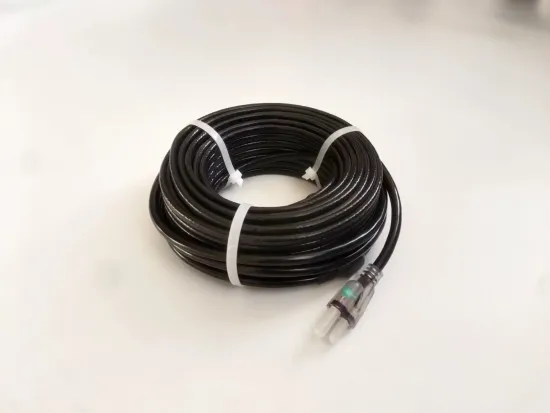
Snow scenery in winter is beautiful, yet it brings numerous hidden safety hazards to building auxiliary facilities. Accumulated ice dams, blocked gutters and hanging icicles are not merely aesthetic issues; they can lead to wall water seepage, damaged roof structures, deformed and cracked gutters, and falling ice poses a severe threat to pedestrians. As an active anti-freezing device, gutter deicing heating cables generate steady heat to melt snow and ice, maintaining unobstructed drainage channels on roofs all winter long. In frigid and snow-prone regions, fast deicing speed, stable operation and wide adaptability make such cables core equipment for winter roof protection of commercial buildings, residential compounds and industrial plants.
Design engineers and property maintenance staff shall select products properly based on local climate, roof structure, laying length and actual working conditions. Anhui Huanrui supplies two complete series of gutter deicing heating cables: constant-wattage and self-regulating types, complying with mainstream industry application logic. Constant-wattage cables serve as the primary deicing solution for large-area, long-distance gutters in severe cold zones, while self-regulating cables are used for irregular structures, complex corners and short-distance supplementary local anti-icing. The two product lines complement each other and cover anti-freezing demands of all working conditions for residential, commercial and industrial roofs.
Formation Principle of Ice Blockages on Roofs and Gutters
Ice dams and clogged gutters mainly stem from unbalanced roof temperature distribution. Indoor heat melts snow on the middle roof surface, while eaves, gutters and downspouts stay below 0°C all the time. Melted snow water refreezes quickly when flowing to cold eaves, gradually building thick ice dams that fully block drainage paths. Backflowed meltwater seeps under roof waterproof layers, resulting in roof leakage, damp walls and structural corrosion.
Water trapped inside gutters expands when frozen, easily causing extrusion deformation and cracking. Heavy icicles hanging from roof edges increase roof load and may trigger safety accidents when falling. Ordinary thermal insulation materials only reduce heat loss instead of generating heat actively, failing to eliminate freeze damage under sustained low temperatures. Only heating cables can deliver continuous heat to keep drainage paths ice-free from roof surfaces through gutters to downspouts.
Two Main Types of Heating Cables and Their De-Icing Performance
The deicing efficiency of gutter heating systems is determined by three key factors: heat output density, laying layout and thermal properties of cables. The industry widely adopts two technical routes with distinct functional positioning, deicing capacity and applicable scenarios rather than being universally interchangeable.
Self-Regulating Gutter Deicing Heating Cables
Self-regulating cables adopt conductive polymer cores to realize automatic temperature adaptation: power rises at low temperatures and drops when warmed up, delivering passive energy-saving effects. Featuring soft texture, they can be cut on site and allow limited local overlapping, offering high construction tolerance. They are ideal for irregular roof structures with numerous complex bends and winding routing.
Restricted by their working principle, self-regulating cables feature low power density and limited capacity to remove thick snow and heavy ice, and suffer gradual power attenuation under long-term ultra-low temperature operation. Therefore, the industry generally applies them only as supplementary deicing solutions for partial heat compensation, short-distance layouts and regions with light snowfall, rather than primary heating for large-area, long-distance main gutters in frigid zones.
Constant-Wattage Gutter Deicing Heating Cables
Constant-wattage cables output stable fixed power without attenuation, delivering sufficient thermal power to serve as the mainstream deicing product for northern severe cold regions, large-area roofs and long-distance gutters with heavy snow and thick ice. Their high power density enables rapid ice melting to unclog drainage passages, with stable performance under 24-hour continuous operation.
Constant-wattage cables are manufactured to fixed lengths as per engineering drawings. On-site arbitrary cutting and cross overlapping are strictly prohibited, requiring high-standard construction specifications. When matched with intelligent control systems integrated with temperature, humidity and weather compensation modules, they realize on-demand startup and precise energy saving, perfectly fitting long-term anti-freezing of large commercial and industrial roofs.
Metal gutters feature outstanding thermal conductivity to spread heat evenly and boost overall deicing efficiency. Plastic and resin gutters lack auxiliary heat conduction, leading to relatively slower ice melting speed under the same power rating.
Laying Layout Schemes for Optimized Deicing Efficiency
Deicing performance depends not only on cable properties but also standardized routing, which is the key to full-range rapid ice removal. The two cable types follow separate construction specifications and cannot share the same laying process.
Zigzag or triangular folded routing is standard for roof eaves: cables extend 15–30 cm upward along roof surfaces beyond exterior walls before looping back into gutters, completely preventing secondary freezing at transition zones between roofs and gutters. Vertical cable spacing shall be adjusted according to roof slope, local maximum snow thickness and minimum ambient temperature.
Self-regulating cables are flexible, cuttable and permitted for partial overlapping, suitable for irregular complex roofs; Constant-wattage cables cannot be cut and cross overlapping is forbidden, applicable to long, straight and regular large-area gutters.
Cables shall be laid continuously along the bottom of gutters and run the full length of downspouts. Additional heating loops are arranged at high ice accumulation zones including roof valleys, dormer junctions, drain outlets and gutter ends to guarantee no icing at vulnerable positions.
All series of deicing heating cables from Anhui Huanrui adopt outer jackets resistant to low temperature, bending and aging, adapting to construction conditions of various building roofs. Contractors may select constant-wattage or self-regulating models flexibly based on structural complexity.
Energy-Saving Performance and Supporting Intelligent Control Systems
Rapid deicing does not require full-load operation around the clock. Intelligent control configurations balance fast ice removal and power consumption reduction. Simple mechanical thermostats fit small buildings and light snow regions to meet basic anti-freezing demands with lower equipment costs; Programmable timing and humidity-linked controllers apply to medium-sized commercial buildings; Large commercial and industrial roofs in northern frigid zones are equipped with Wi-Fi intelligent controllers linked to weather forecast data, which preheat roofs in advance before predicted snowfall to prevent ice accumulation from the source instead of melting ice after formation.
The full set of control systems from Anhui Huanrui are compatible with both constant-wattage and self-regulating gutter deicing cables, covering basic thermostats and cloud-connected intelligent controllers with weather linkage. Facility managers may configure control schemes matching project scale and budget. Self-regulating cables save energy passively via polymer characteristics, while constant-wattage systems cut redundant power consumption through active zoned timing control. Properly matched, both types effectively reduce unnecessary energy use and fit different project grades and budgets.
Conclusion
Gutter deicing and anti-freezing work is a critical part of winter building maintenance in snow-heavy cold regions. The two cable types have clear technical positioning and complementary application scenarios: Constant-wattage cables deliver ample thermal power and stable long-term performance, acting as the primary deicing solution for large-area, long-distance layouts under sustained ultra-low temperatures; Self-regulating cables feature high flexibility and easy installation, suited for irregular roofs, complex joints and local supplementary heat supply.
Supported by a complete full-product portfolio, Anhui Huanrui provides customized deicing system solutions for residential buildings, commercial complexes, factories and venues of all scales. Through scientific product selection, standardized laying and intelligent control, the systems efficiently eliminate hidden risks such as ice dams, clogged drainage and falling icicles, protect building structural integrity and deliver worry-free anti-freezing performance throughout the whole winter.