 EN
EN
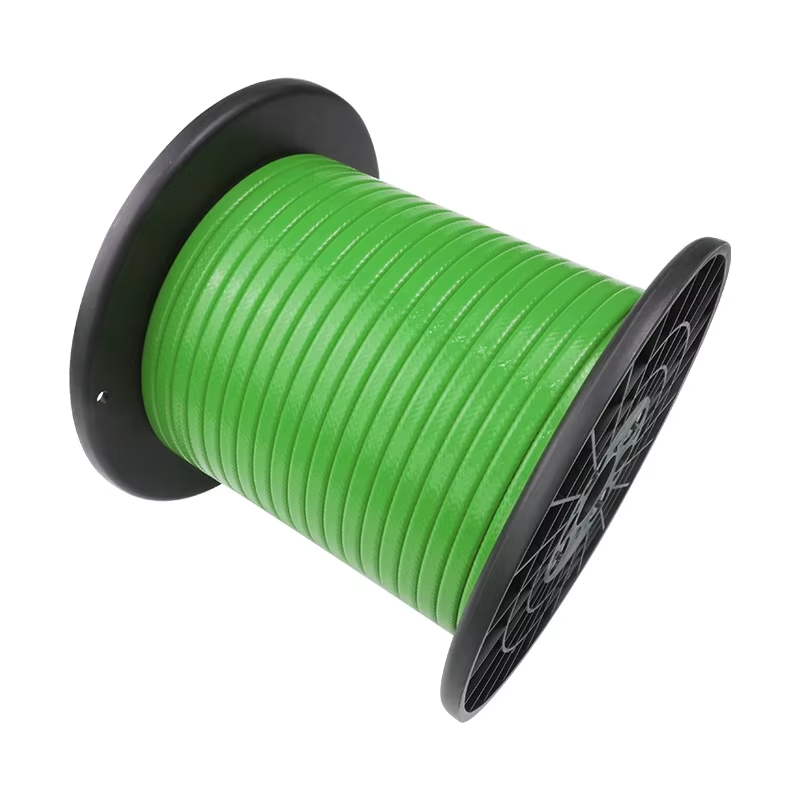
Falling temperatures bring frost and ice accumulation, which easily damage residential, commercial and industrial buildings. Conventional constant-wattage heating cables are prone to overheating, fire hazards and electrical breakdown. Premium self-regulating heating cables adopt inherent PTC temperature-limiting design and multi-layer safety construction to deliver superior performance. This article illustrates core safety merits of qualified self-regulating heating cables across diversified application fields.
Working Principle of Self-Regulating Technology
The outstanding safety performance originates from its unique structure: a proprietary carbon-doped conductive polymer PTC core is sandwiched between two parallel bus wires. The polymer shrinks at low ambient temperature to form extra conductive paths and raise heat output; it expands with rising temperature to cut conductive channels and reduce power automatically. Each cable segment adjusts heat output independently according to local surrounding temperature.Thanks to self-limiting features, external thermostats can be omitted for common non-explosion-proof freeze protection such as water pipeline and gutter de-icing to cut potential failure points of auxiliary electrical parts. Nevertheless, thermostats are mandatory for hazardous explosive locations and precise process temperature maintenance in line with global and domestic safety codes.
Reduced Overheating and Fire Risks
With built-in PTC characteristics, qualified self-regulating cables decrease power output spontaneously under rising temperature and stay within designed surface temperature under normal operation, drastically lowering overheating and fire possibilities. However, over-temperature risks still exist under abnormal conditions including insulation damage, overvoltage supply and long-term chemical corrosion, so zero fire risk cannot be fully guaranteed.Low-temperature self-regulating cables can be installed directly onto plastic pipes without spacer, while medium & high-temperature grades require thermal insulation between cable and plastic piping to avoid thermal deformation. The inherent temperature control enables safe operation without thermostats for ordinary non-hazardous freeze protection projects.
Safe Installation with Overlapping Runs
Cable overlapping is unavoidable when wrapping valves, irregular pipes or routing along roof valleys and gutters. Overlapped constant-wattage cables accumulate concentrated heat and incur high fire risk; by contrast, premium self-regulating products drop power mutually at overlapping spots to maintain safe surface temperature. Installers can arrange routing flexibly without avoiding cross positions, lowering safety risks from improper construction.
Multi-layer Electrical & Flame Safety Configuration
Apart from intrinsic PTC self-regulation, premium cables can be equipped with optional safety structures. LSZH (Low Smoke Zero Halogen) jacket is an optional choice rather than mandatory standard, which cuts smoke emission by roughly 90% and features self-extinguishing performance to win more evacuation time in confined spaces like cable tunnels and indoor equipment rooms.A continuous tinned copper braided grounding layer is equipped for reliable earthing; when connected with GFCI/RCD protective devices rated at 30mA trip current, the whole system provides effective protection against electric shock. Outer sheath alternatives include flame-retardant polyolefin for general outdoor use and fluoropolymer for chemical-corrosive working conditions.
High Construction Tolerance against Ordinary Installation Errors
Improper installation is a leading cause of tracing failure. Non-explosion-proof self-regulating cables can be field-cut to required length to reduce leftover waste and terminal faults; ATEX/IECEx certified explosion-proof variants shall not be arbitrarily cut on site, and factory-certified explosion-proof end seals are compulsory once segmentation is needed.Owing to overlap-safe property, installers do not need to eliminate all cable crossings; low-temperature cables can contact plastic substrates directly while high-temperature versions need additional thermal barriers, simplifying auxiliary material deployment and construction cost.
Authoritative Certification for Compliance & Quality
Qualified self-regulating cables pass strict third-party testing and obtain corresponding certifications: UL and CSA are essential for North American market access; CE serves as basic EU market approval, with general tracing under LVD directive and explosion-proof CE supported by separate ATEX certification. ATEX is compulsory for EU hazardous areas and IECEx widely accepted for global overseas explosive projects, whereas CNEX certification is legally required for domestic hazardous locations in China. These certificates verify compliance on insulation, flame retardancy, thermal stability and mechanical strength to guarantee safety under extreme working conditions.
Practical Safety Performance in Real Projects
A typical application is freeze protection of outdoor emergency fire hoses under subzero climate: self-regulating cables modulate heat output automatically to prevent hose freeze-up without thermal erosion on hose materials and avoid emergency suspension caused by frozen pipelines.Besides, such cables are widely applied for potable water lines, fire sprinkler piping, industrial process tracing and roof & gutter de-icing to prevent ice-dam collapse, falling icicle injuries and building water leakage. It is worth noting that constant-wattage and MI mineral-insulated heating cables also possess prominent safety advantages for ultra-high-temperature and long-distance industrial pipelines for targeted selection.
Proper Selection & Maintenance to Maximize Safety
Self-regulating products vary greatly in quality across manufacturers. End-users are recommended to select well-established suppliers with complete certification portfolios, preferring radiation-crosslinked PTC core for outstanding anti-aging property; LSZH jackets for enclosed fire-related sites and fluoropolymer outer jackets for corrosive environments.Safety also relies on standardized installation and periodic maintenance: all matching accessories including connection kits and end seals shall carry identical explosion-proof certification as cables for hazardous-area systems, while accessories for ordinary non-explosion projects only need to satisfy domestic GB electrical standards. Regular inspections on jacket damage, water ingress and chemical corrosion plus periodic insulation resistance & earthing continuity tests secure long-term safe operation.
Conclusion
Premium self-regulating heating cables deliver remarkable safety advantages compared with conventional constant-wattage products, featuring inherent overheat prevention and safe overlapping installation for low-maintenance freeze protection. Optional LSZH sheath and continuous grounding further upgrade overall safety performance. Nevertheless, constant-wattage and MI mineral-insulated cables are irreplaceable with superior safety for high-temperature and high-risk explosive applications. When safety is prioritized, properly specified high-quality self-regulating heating cables constitute a reliable solution for freeze protection.
Table of Contents
- Working Principle of Self-Regulating Technology
- Reduced Overheating and Fire Risks
- Safe Installation with Overlapping Runs
- Multi-layer Electrical & Flame Safety Configuration
- High Construction Tolerance against Ordinary Installation Errors
- Authoritative Certification for Compliance & Quality
- Practical Safety Performance in Real Projects
- Proper Selection & Maintenance to Maximize Safety
- Conclusion